Why adding friction in marketing can help you stand out in London
Marketing
Brand strategy
London
12 Nov 2026

Rosie Lees
Senior account executive

London’s fast-paced nature has a habit of infiltrating consumers – pushing impulsive purchases and snap decisions. You can't step on the tube for your commute to work without being bombarded with ads at every turn.
Despite this, many Londoners are constantly looking for prestige and exclusivity and a reservation at the next best restaurant is the ultimate upper hand. So, what can you do to set yourself apart from competitors and phase out low intent customers in a crowded market?
In the first of our London spotlight series from our team in the capital, we'll be considering how adding friction in marketing can do just that.
What is a marketing friction strategy? Key considerations
- Intentional friction in marketing can build value, trust and brand recall - such as the ‘IKEA effect’, which sees people putting a higher value on something they've had a hand in creating
- Bad friction also exists – niggles such as slow loading pages can cause customers to drop off before they've clicked 'buy'
- In London, friction can filter out low-intent customers, increase exclusivity and build trust, differentiating your brand from one that wants quick sales
Psychology of friction marketing
When we refer to friction in marketing, we are talking about any hurdle or effort required by a consumer in the process of converting from curiosity to purchase.
Traditionally, marketers have wanted to remove as much of this friction as possible to avoid customer drop-off, but there is growing awareness in the industry around how intentional friction can build value, trust and brand recall.
A great example of this is the IKEA effect. If you've put time and effort into building a piece of flat pack furniture, you are likely to value the end result more. The same is true for anything to which you apply mental labour and emotional ownership, such as a greater stake in decision-making and personalisation of experience.
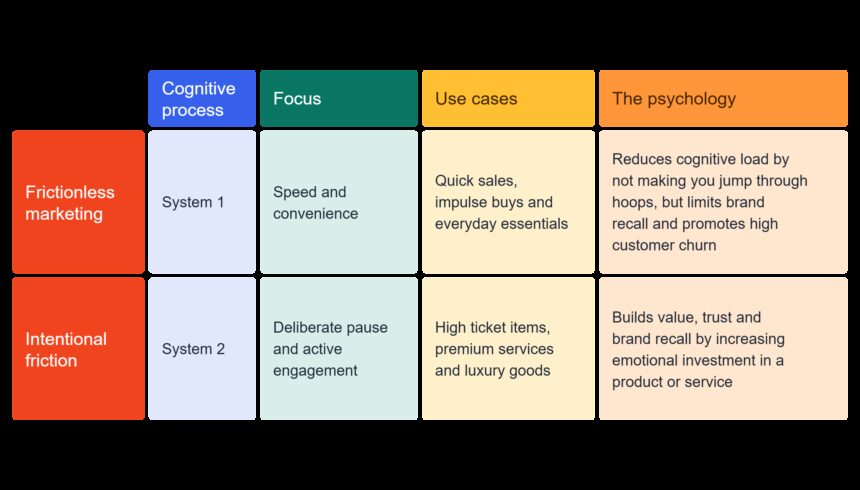
This is a shift from System 1 to System 2 thinking, with the latter forcing us to move away from fast instinctive decisions and toward slower thinking. While System 1 may be fine for routine purchases – often driven by strong brand familiarity – pushing consumers to use the more conscious System 2 aids deep memory and brand retention.
Good friction vs bad friction
Of course, not all friction creates a positive experience. There is still a risk that you can unnecessarily slow down the customer experience and ultimately prevent them from completing a purchase. So, what's the difference between good friction vs bad friction?
Bad friction
Slow-loading webpages, forced account creation and confusing checkout forms all fall under the bracket of bad friction when shopping online. These cause moments of frustration that can not only lead to abandonment but also lowers the chance of customers returning and recommending your brand to a friend.
With 80% of shoppers saying they will abandon a retailer after just three bad experiences these things aren't just an inconvenience, but instead the difference between making a sale or not and retaining or losing a customer.
Good friction
When done well, good friction can have the opposite effect. These instances are still designed to make consumers take a pause, but with the result of better decision making and more valuable purchases.
Some examples of good friction are:
- Diagnostic quizzes
- Interactive calculators
- Checkout review screens
- Customisation and personalisation
- Wait lists or queues
The benefits of good friction
We are increasingly seeing how – when done correctly – friction can offer great results. To give an example from our client Woolroom, the brand offers a comparison tool that enables you to look at your options side-by-side. Although this adds an additional step to the purchase process, the extra effort is rewarded with higher product satisfaction.
These methods can also filter out high-intent clients, increase inclusivity and build trust. Here’s how:
Friction filtering
By introducing a quiz or waitlist you are automatically going to capture the high-intent consumers – the ones who want to take time out of their day to take the additional step for the sake of a more personalised product recommendation or experience - and filter out those who are after a quick win.
This is particularly important in London, a city where ads are plastered across buses, train station platforms and tubes.
Although Transport for London's underground network sees 4 million journeys on a busy weekday, and large scale out of home ads deliver 2.4 daily impressions, creating a frictionless journey won't necessarily result in more sales.
Exclusivity
A big part of brand differentiation in London is wanting what others don't have access to. In premium sectors, this positive friction of limited access is synonymous with prestige. Think limited edition clothing drops and appointment-only shopping experiences.
In the hospitality world, that highly-sought-after restaurant reservation is the perfect example. It's not uncommon for the top eateries in London to be fully booked for weeks, if not months in advance. By opening bookings incrementally, it makes them more limited and ultimately forces customers to wait. This can create the perception of more popularity and an elevated status. The delayed gratification adds to that sense of emotional buy in, and there's no forgetting the restaurant name that's been in your calendar for weeks.
Building trust
If your goal is to be the go-to, trusted provider of your product or service then targeting quick leads and frictionless marketing isn't going to win you any points - or long-term customers.
Adding good friction to your marketing strategy, and being more selective about your customer base, can build your credibility in the space.
In B2B marketing, such as Cartwright's work in property and construction, asking leads to fill in a short form or complete a survey detailing their needs give both parties greater assurance that the resulting partnership is a good fit. The ultimate goal is returning customers and high-quality referrals.
Ready to discuss friction marketing?
Whether you are trying to drive more high-intent leads from your customer base in the capital or want to ensure you have the right friction marketing in place, we can ensure a smooth process.